
Classic Stories are those stories that expresses artistic
quality--an expression of life, truth, and
beauty.
We bring some popular classic stories for kids.
1.
The Jungle Book
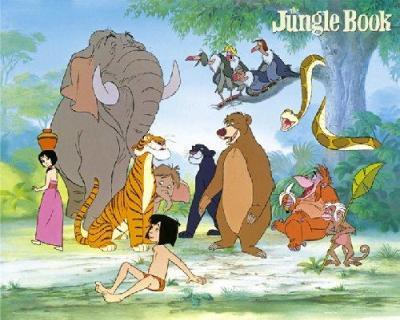
In the thick of a jungle in India, a little boy is
playing with wolf cubs. Mother wolf is there. She says to the
little boy, "Mogli, be careful, you could hurt
yourself."
Mogli, as an infant had been found by the wolf in the
jungle; she had brought him up just as she had brought up her own
cubs. Mogli, still a boy played with all the animals in the jungle.
He had many friends; Bhaloo, the bear. Bhagera, the panther and his
many monkey friends. But Sher Khan, the tiger was no fiend. Mogli
had always been warned to stay away from Sher Khan's territory.
Sher Khan did not like Mogli and waited for a chance to harm the
boy.
One day, while Mogli was playing, Bhaloo came running to
Mogli and said, "Mogli, Sher Khan is in a terrible temper. He is
going around telling everyone that he wants to kill you." Mogli
said, "Don't worry Bhaloo, I can protect myself."
Mogli had a plan. It was to counter attack. He wanted to
let loose the wild bulls of the forest on Sher Khan. To do this he
had to corner Sher Khan. He knew where Sher Khan spent most of his
time; it was on a slope in the mountains, far from Mogli's cave. He
did not want Sher Khan to spot him because that would be the end of
him. Mogli thought, "I should go around the mountain and to the top
without Sher Khan seeing me. From the top the bulls can charge at
Sher Khan."
That evening, Mogli gathered eight wild bulls with the
longest and sharpest horns. He said, "Today, we will put an end to
the reign of terror by Sher Khan. This is my plan." Mogli explained
to the bulls how he wanted to attack Sher Khan.
As per plan, they circled the mountain, unnoticed by the
slumbering tiger. Once they reached the top, they could see in a
clearing a little below rested Sher Khan. Mogli said, "Once I give
you the signal, charge together. Any false move and we could be
endangering out lives." Mogli lifted up his hands, brought it down
and shouted, "CHARGE."
The bulls ran down the slope, kicking up huge amounts of
dust. Sher Khan looked up hearing this thunderous noise. He saw the
bulls hurtling towards him; he tried to turn and run but before he
knew it the bulls were on top of him. The bulls pierced Sher Khan
with their horns and flung him with the momentum of their run. Sher
Khan was hurled and flung to his death.
Mogli and the bulls proudly went to announce to the jungle
folks of Sher Khan's end.
2. Aladdin And
The Magic Lamp
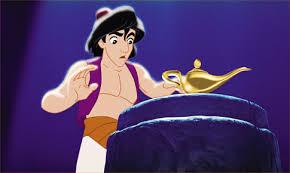
Long time ago in China, there lived a poor boy, whose
name was Aladdin. Aladdin lived with his mother. One day a rich and
distinguished looking man came to their house and said to Aladdin's
mother, "I am a merchant from Arabia and want your son to come with
me. I will reward him handsomely." Aladdin's mother instantly
agreed. Little did she know that the man pretending to be a rich
merchant was in reality a magician.
Next day, Aladdin having packed his belongings left with
the 'merchant'. After many hours of traveling the 'merchant'
stopped. Aladdin too stopped, surprised that they should stop in
such a desolate spot. He looked around; there was nothing in sight
for miles.
The 'merchant' pulled out some colored powder from his
pocket and threw in the ground. The next instant the whole place
was filled with smoke. As the smoke cleared, Aladdin saw a huge
opening in the ground; it was a cave. The 'merchant' turned to
Aladdin and said, "I want you to go inside this cave; there will be
more gold than you have ever seen; take as much as you want. You
will also see an old lamp; please bring that back to me. Here, take
this ring; it will help you." Aladdin was very suspicious but the
decided to do as was told.
He lowered himself into the cave, thinking all the while
that it would be difficult to climb out without help. Aladdin
entered the cave and just like the 'merchant' had said saw gold,
jewelry, diamonds and other valuables. He filled his pockets. When
this was done, he looked for the lamp; it was lying in the corner,
full of dust and dirty. He picked it up and ran to the cave's
opening and shouted to the 'merchant', "I have your lamp. Can you
please pull me out?" "Give me the lamp," said the 'merchant'.
Aladdin was not sure that he would be pulled out if he gave back
the lamp; so he said, "First, please pull me out."
This angered the 'merchant'. With a loud cry, he pulled out
the same colorful powder and threw it on the cave opening, sealing
it with a huge boulder. Aladdin was depressed. He thought, "That
was no rich merchant; he was surely a magician. I wonder why this
lamp was so important to him." As he was thinking he rubbed the
lamp. All of sudden a strange mist filled the room and from the
mist emerged a stranger looking man. He said, "My master, I am the
genie of the lamp, you have rescued me; what would your wish be?"
Aladdin was scared but he said in quivering voice, "Ta.. Take me
back home."
And the next moment Aladdin was home hugging his mother. He
told her of the magician and the lamp. Aladdin again summoned the
genie. This time when the genie appeared he was not scared. He
said, "Genie, I want a palace, not an old hut." Again to Aladdin
and his mother's amazement in front of them was a magnificent
palace.
Time passed. Aladdin married the Sultan's daughter and was
very happy. It so happened that the evil magician got to know of
Aladdin's good fortune. He came by Aladdin's palace pretending to
exchange old lamps for new. The princes, Aladdin's wife, not
knowing the value of the lamp to Aladdin called out to the magician
to wait.
As soon as the magician saw the lamp he grabbed it from the
princess' hand and rubbed it. The genie appeared, "you are my
master and your wish is my command," he said to the magician. "Take
Aladdin's palace to the great desert faraway from here," ordered
the magician.
When Aladdin came home, there was no palace and no
princess. He guessed it must be the evil magician who had come to
take revenge on him. All was not lost, Aladdin had a ring that the
magician had given to him. Aladdin pulled out that ring, rubbed it.
Another genie appeared. Aladdin said, "Take me to my
princess."
Soon, Aladdin was in Arabia with his princess. He found his
lamp lying on a table next to the magician. Before the magician
could react, Aladdin jumped for the lamp and got hold of it. As
soon as he had the lamp, Aladdin rubbed it.
The genie appeared again and said, "My master, Aladdin, it
is indeed good to serve you again. What is it that you wish?" "I
want you to send this magician to another world so that he never
harms anybody," said Aladdin. Aladdin's wish was carried out; the
evil magician disappeared forever.
The genie carried Aladdin, the princes and the palace back
to China. He stayed with Aladdin for the rest of his
life.
3. Gulliver's
Travels
One stormy night at sea, a ship was wrecked. All the
passengers on board drowned, except Lemuel Gulliver. Gulliver was a
excellent swimmer and swam for many miles before he reached shore.
Gulliver was very tired and decided to sleep. He would look for
food after he had had sufficient rest.
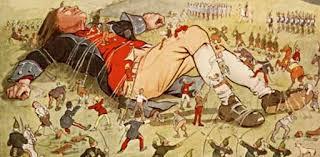
Gulliver slept for a whole day. When he woke up, the Sun
was beating down upon him. He tried to move, he could not. His
hair, hands, legs and body were tied to the ground. He saw little
men running all around him. Someone had got a tiny ladder and was
climbing up to him. The little man, no bigger than Gulliver's thumb
nail, came up to him ears and said, "You are in the land of
Lilliput; we are Lilliputians. We are taking you to our Emperor, so
please do not make any trouble. You will be shot at." Gulliver
almost laughed at this threat but nodded.
A huge wooden structure with wheels was brought. Gulliver
was slid on to it after much struggle. The wooden structure was
pulled through the streets of Lilliput with all the Lilliputians
lining up the streets.
It was a carnival atmosphere which the Lilliputians seemed
to be enjoying themselves, much to the amusement of
Gulliver.
Finally, they arrived at the Emperor's palace. The Emperor
was there to receive Gulliver, "You are indeed a strange sight. If
you are to stay here you will have to be of service to my people
here," he said pointing to the crowd. Gulliver said, "I agree to
any condition but only if you untie me."
Gulliver was freed. He was provided with food and water, a
house was built for him. It was a monumental effort by the
Lilliputians, who were all out to serve Gulliver. Gulliver stayed
with the Lilliputians, helping them with many small
tasks.
It so happened, that the neighboring kingdom of Bleuse were
not on very friendly relationship with Lilliput. The King of Bleuse
declared war on Lilliput. He took a hundred ships to mount an
attack.
The Lilliputians ran to Gulliver for help. The Emperor
said, "Don't let us down now Gulliver; we need your help." Gulliver
walked into the sea. He took long rope, tied all the hundred ships
together and dragged them in the water. Gulliver pulled the ships
the whole day, until the army of Bleuse was giddy and in no
position to fight.
The King of Bleuse came begging for peace between the two
kingdoms. The Emperor agreed. Gulliver was hailed as the hero and
lived in Lilliput for many years.
4. A Tale of Two
Cities
Lucie was a young, beautiful girl who was in love with
Charles Darnay. Lucie's father, a doctor, had been imprisoned in
Paris on false accusations of having killed a woman.
Lucie often went to meet her father in prison. One day, the
French police got evidence that it was not Lucie's father who had
committed the murder but two noblemen. The noblemen were Charles
Darney's father and uncle. They had ill treated a peasant woman,
who had later died.
When Lucie's father was released from prison, she looked
after him well. Lucie's father who had been a sick man in prison,
now got back to good health. He had a lawyer, Sidney, who often
visited him. Sidney fell in love with Lucie.
When Sidney came to know that Lucie was in love with
Charles Darnay, he decided not to tell Lucie of his love for her.
Charles and Lucie were married.
In the year to come the French revolution destroyed the
peace of Lucie and Charles. Charles was arrested and sentenced by
court to be executed. He was accused of having aided his uncle and
father in the murder of the peasant women for which Lucie's father
too had been sentenced. Charles was innocent.
Lucie was heartbroken. Sidney, who was by Lucie's side in
these trying times, came up with a suicidal plan. Sidney's plan was
to have Charles escape to London from Paris wearing Sidney's
clothes Sidney was the one to be executed. He told Lucie the plan.
She said, "No, Sidney, you cannot walk to your death." Sidney
confessed his love for her and said, "This is my ultimate
sacrifice."
He went to the prison in Paris to meet Charles. In prison,
with the guards back turned towards them, Sidney said, "Charles,
quickly remove your clothes and give it me. Do not say a word.
Here, you can wear my clothes." Sidney removed his clothes. Once,
Charles was dressed in Sidney's clothes, Sidney said, "Outside you
will find Lucie waiting; your train tickets to London are booked."
"But Sidney, why are you doing this?" Sidney just smile and said,
"Hurry Charles, Lucie's waiting."
The plan worked. Charles Darnay and Lucie escaped to
London. Sidney was executed. He had indeed made the ultimate
sacrifice.
5. Around The World In
Eighty Days
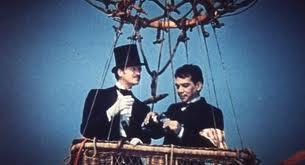
In a club, in England, there was a heated discussion.
Phileaus Fogg had taken a bet with certain members of the club that
he could travel around the world in eighty days.
"Impossible," said Joseph Cain, one of the members, "You
cannot travel to every continent in eighty days." " It's a bet,
gentlemen. Twenty thousand pounds," said Phileaus confidently.
"That is a bet," said the members.
Phileaus Fogg had not made an empty boast. He was very
correct gentleman and had made precise calculations with a world
map. He had decided that eighty days were enough to travel round
the world.
Phileaus Fogg's bet was well published in all newspapers in
and around England. It so happened that a big diamond burglary had
taken place a few days earlier. Phileaus's face fitted the
description of the man who was wanted for the burglary. Scotland
Yard appointed a man, Fix, to follow Phileaus.
Phileaus Fogg along with his personal assistant,
Passepartout, packed their bags to start their journey. Phileaus
had a chart. First stop was from London to Suez, seven days by rail
and steamer.
Phileaus fogg and Passepartout reached the Suez and from
there set sail to Bombay by steamer, a thirteen day journey. Fix
came face to face with Fogg on this journey, "Were you not on the
steamer to Suez?" asked Fogg. "Yes," replied Fix
uneasily.
Once they reached Bombay, Phileaus and Passepartout checked
into a Hotel., with Fix right behind them. In Bombay Phileaus was
informed that the king had died and the queen was to commit sati,
that is, jump into the funeral pyre of her husband.
Phileaus Fogg was not a man to sit down and do nothing
about it. He and Passepartout went to rescue the queen on elephant
back. They were just in time. The queen had been drugged and was
about to be thrown into the fire, when Phileaus intervened. He
carried the queen back to the Hotel.
Phileaus Fogg realized that the queen was very beautiful.
He fell in love with her and proposed to marry her. She agreed.
They were married immediately. Phileaus Fogg told his new bride of
his bet, "We will have to leave Bombay and move on the Calcutta and
from there on to Hong Kong. A sixteen day journey."
They reached Hong Kong, Mr. and Mrs. Fogg and Passepartout
followed closely by Fix. Fogg had noticed that Fix seemed to be
everywhere they went. He ignored Fix.
They left Hong Kong and headed to Japan and from Japan to
San Francisco. A twenty eight day journey. Fix was getting really
tired following Phileaus Fogg. Here was a man who never rested. He
had found a bride and got married in a single day; kept on the move
jumping from Rail to Road to Sea. All this seemed to be taking a
toll on Fix.
In San Francisco, Phileaus Fogg again saw Fix lurking
somewhere behind him. He waited until Fix was alongside him and
asked, "What is your game, Sir? You have been following me from
London all the way to the Suez to Bombay and now here." Fix was
speechless. He said, "I..I..It's just a coincidence.
Phileaus Fogg was now on his way to New York and then to
his final destination London, another sixteen days. The journey to
New York and London went without a hitch, except for the annoying
presence of Fix who tried his best not to be seen.
Everything was fine until Phileaus Fogg realized that he
had not taken the different time zones into consideration, he was
shocked to realize that he would be a day late. He was supposed to
reach London on the morning of Sunday and win his bet. Phileaus
Fogg would now reach on Monday. He walked home dejected. He lay in
bed, when suddenly his eye caught the calendar. He called
Passepartout, "Is it you who has changed the calendar. What day is
it today?" He had told nobody that his calculations had been wrong.
"It is Saturday, Mr. Fogg. You have won the bet, I would have told
you but you seemed so dejected for some reason."
Phileaus Fogg rejoiced. He ran to the club to tell the
members that, "He had indeed won." The members of the club gladly
paid Phileaus Fogg his twenty thousand pounds. As for Fix he came
to know that the thief had been caught the same day he had started
on the trail of Phileaus Fogg.
6.
Frankenstein

Frankenstein was a genius. As a boy Frankenstein always
wanted to know and learn. He loved experimenting. Frankenstein grew
up to be a doctor.
One day, Frankenstein was sitting in his library when a
thought struck him, "Could he take pieces of human body and make a
perfect human being?" The question rankled in his brain. "But what
about giving this mass of flesh, life." He questioned himself. The
answer came to him almost instantly. "Electricity, a great big
shock of electric current."
The following day onwards Frankenstein started digging up
bodies from the grave, amputating either the legs or hands. No one
knew of this strange eerie experiment. As days past Frankenstein
had all the parts of a human body. He had carefully stitched each
piece together. What lay in his laboratory now was a monster of a
man with no life in him.
Frankenstein thought, "Now for the final step, to pass
great big bout of electricity through this monster." All
preparations were made. A lever was moved and ZAP....the monsters
body shook with the powerful blasts of current.
Everything was silent for a moment, then the monster
stirred and slowly stood up. He looked much bigger than when he was
lying down, he stood at eight feet and weighed two hundred
kilos.
Frankenstein's euphoria of a successful experiment was
short lived. The monster was now coming towards him. The monster
walked past Frankenstein smashing the door into the streets. Terror
reigned in the streets. Anyone who saw the monster ran for their
lives. The monster destroyed everything. Shops were razed to the
ground and glasses smashed. Somebody had to stop the
monster.
In his house Frankenstein himself was in shock; his monster
was creating havoc in the city; he had to stop it somehow. He
decided to confront the monster.
Taking a gun with him Frankenstein went in search of the
monster. He found him in one of the street corners. Frankenstein
fired all the bullets in the gun at the monster's head, shoulders
and chest, killing him.
Frankenstein swore to himself to never ever experiment with
nature.
7. Robin
Hood
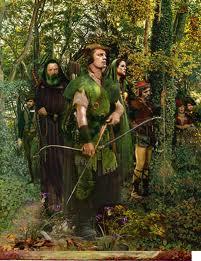
Long ago, in England in Sherwood forest live Robin Hood.
As a boy Robin had been cheated by a few noblemen and since then he
had decided hat he would not spare the rich. He would rob the rich
and give to the poor.
The Sheriff of Nottingham had placed many rewards for the
capture of Robin Hood but nobody had ever caught him. Robin Hood
had a number of men who served him; they had made him their leader.
They acted as informers; they would warn Robin Hood whenever the
Sheriff had any new plan to catch him.
The rich were scared of going through Sherwood Forest
because they knew Robin Hood would attack. The pressure mounted on
the Sheriff of Nottingham to capture Robin Hood. He went to take
the help of the king. The king refused to send any of his men to
help in the capture of Robin Hood.
Finally, the Sheriff thought of a plan. "Let us have a
competition to choose the best shooter in Nottingham. Robin Hood
cannot resist such a competition. He will surely come, when he
does, my guards will capture him," he told his noblemen. All of
them agreed.
Now, Robin Hood was an excellent shooter; there was none
better than him with a bow and arrow in the whole of Nottingham.
And Robin Hood could surely not resist taking part in any
competition to prove that he was the best.
Robin Hood's loyal men dissuaded him. "Robin, this
competition is being held to trap you," said one of the men. "It
would be foolish to talk into the lion's den," said another. But
Robin Hood was not willing to listen.
So, the next day all arrangements for the competition were
made. The crowds were all seated and ten contestants were there.
The Sheriff turned to one of the guards and asked in a whisper,
"Has Robin come?" "No, Your Highness, Robin has red hair. None of
the contestants have red hair." The Sheriff said, "He must be
scared."
The competition began. William, the Sheriff's man, who had
also participated and man in a green outfit were vying for the
first prize, a golden arrow, after ten rounds. It was time for the
last arrow to be shot; the winner of this round would be declared
the best shooter in Nottingham.
William took aim first and shot; it was very close to the
center. The Sheriff applauded. "Good shot, William," he said. Then
it was the turn of the man in green; he let go of his arrow. The
crowd cheered hysterically. It went through William's arrow and
bull's eye. And within a flash the man in green let go of two more
arrows which came flying towards the chair on which the Sheriff sat
and stuck on either side of it. The Sheriff was
stunned.
The man in green was none other than Robin Hood. Before the
Sheriff recovered, he pulled off his black wig, threw it in the
ground, jumped over a wall on to his waiting horse and was gone.
"Get him, you fools. That is Robin Hood," shouted the helpless
Sheriff, but it was too late. Robin Hood had escaped
again.
8. The Princess and the
Pea
There was once a prince, and he wanted a princess, but then she must be a real Princess. He travelled right around the world to find one, but there was always something wrong. There were plenty of princesses, but whether they were real princesses he had great difficulty in discovering; there was always something which was not quite right about them. So at last he had come home again, and he was very sad because he wanted a real princess so badly.
One evening there was a terrible storm; it thundered and lightning and the rain poured down in torrents; indeed it was a fearful night.
In the middle of the storm somebody knocked at the town gate, and the old King himself sent to open it.
It was a princess who stood outside, but she was in a terrible state from the rain and the storm. The water streamed out of her hair and her clothes; it ran in at the top of her shoes and out at the heel, but she said that she was a real princess.
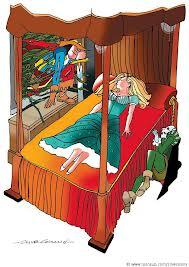
‘Well we shall soon see if that is true,’ thought the old Queen, but she said nothing. She went into the bedroom, took all the bed clothes off and laid a pea on the bedstead: then she took twenty mattresses and piled them on top of the pea, and then twenty feather beds on top of the mattresses. This was where the princess was to sleep that night. In the morning they asked her how she slept.
‘Oh terribly bad!’ said the princess. ‘I have hardly closed my eyes the whole night! Heaven knows what was in the bed. I seemed to be lying upon some hard thing, and my whole body is black and blue this morning. It is terrible!’
They saw at once that she must be a real princess when she had felt the pea through twenty mattresses and twenty feather beds. Nobody but a real princess could have such a delicate skin.
So the prince took her to be his wife, for now he was sure that he had found a real princess, and the pea was put into the Museum, where it may still be seen if no one has stolen it.
9. Treasure
Island
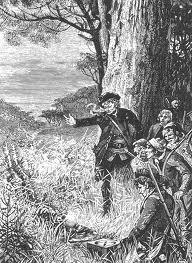
Jim Hawkins loved adventure. When a blind man by the
name of Black Dog came to live with him and his mother in their
Inn, Jim had no idea he was to get into one great big dangerous
adventure.
Black Dog was an unfriendly old man. One morning, Black Dog
was found dead in his room. Jim and his mother opened his trunk and
found an old map. It looked like a treasure map. Jim was excited
and told his mother that he would go and look for the treasure. But
before that he went to meet the village Squire.
"Sir, this is what I have found in the blindman's trunk who
died yesterday. It looks to me like a map of some hidden treasure,"
said Jim to the Squire pulling out the map. " Indeed it does,"
agreed the Squire. "We should set sail immediately to look for this
treasure."
So, the next day, Jim and the Squire boarded a ship, to set
sail to an unknown island, looking for treasure. It was a long
journey. In the ship Jim met an one-legged sailor who was the
ship's cook. His name was Long John Silver. He always had his pet
parrot perched on his shoulder. Silver was very friendly and had
Jim rolling with laughter with his stories.
One stormy night Jim feeling hungry, walked up to one of
the barrels that contained apples. Suddenly, he heard voices, Jim
felt suspicious and jumped inside the barrel. Once inside he froze.
Long John Silver was talking. He was saying, "Tomorrow we will
reach Treasure Island. As soon as I give the signal we will take
all passengers on board as prisoners. Then we can take the map and
dig up the treasure. Let us go back to our places before anyone
sees."
When Jim was sure everyone had gone, he climbed out of the
barrel. He immediately warned the Squire of Long John Siler's plan.
The next morning, the island was visible in the distance, Jim
jumped off the ship and swam to shore. There he met a ragged old
man, who said, "I am Ben Gunn, I have been shipwrecked in this
island for twenty years. I suppose you have come to look for the
treasure." Jim nodded and said, "I jumped off the ship, there are
dangerous men on that ship. Please help me, my friend the Squire is
on that ship too."
Ben Gunn knew the island very well. He laid out traps for
Long John Silver and his men. When they came shouting and waving
their guns, they fell into a hole in the ground dug by Ben Gunn.
They were trapped. Jim and Ben Gunn unearthed the treasure and swam
to the ship. Jim, Ben and the Squire sailed back home leaving Long
John Silver and his men in the island forever.
10. A Child's Dream of a
Star
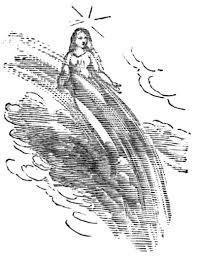
There was once a child, and he strolled about a good deal, and thought of a number of things. He had a sister, who was a child, too, and his constant companion. These two used to wonder all day long. They wondered at the beauty of the flowers; they wondered at the height and blueness of the sky; they wondered at the depth of the bright water; they wondered at the goodness and the power of God who made the lovely world.
They used to say to one another, sometimes: "Supposing all the children upon earth were to die, would the flowers, and the water, and the sky be sorry?" They believed they would be sorry. "For," said they, "the buds are the children of the flowers, and the little playful streams that gambol down the hillsides are the children of the water; and the smallest, bright specks playing at hide and seek in the sky all night, must surely be the children of the stars; and they would all be grieved to see their playmates, the children of men, no more."
There was one clear, shining star that used to come out in the sky before the rest, near the church spire, above the graves. It was larger and more beautiful, they thought, than all the others, and every night they watched for it, standing hand in hand at a window. Whoever saw it first cried out: "I see the star!" And often they cried out both together, knowing so well when it would rise, and where. So they grew to be such friends with it, that, before lying down in their beds, they always looked out once again, to bid it good-night; and when they were turning round to sleep, they used to say: "God bless the star!"
But while she was still very young, oh, very, very young, the sister drooped, and came to be so weak that she could no longer stand in the window at night; and then the child looked sadly out by himself, and when he saw the star turned round and said to the patient, pale face on the bed: "I see the star!" and then a smile would come upon the face, and a little weak voice used to say: "God bless my brother and the star!"
And so the time came all too soon, when the child looked out alone, and when there was no face on the bed; and when there was a little grave among the graves, not there before; and when the star made long rays down towards him, as he saw it through his tears.
Now, these rays were so bright, and they seemed to make such a shining way from earth to heaven, that when the child went to his solitary bed he dreamed about the star; and dreamed that, lying where he was, he saw a train of people taken up that sparkling road by angels. And the star, opening, showed him a great world of light, where many more such angels waited to receive them.
All these angels, who were waiting, turned their beaming eyes upon the people who were carried up into the star; and some came out from the long rows in which they stood, and fell upon the people's necks, and kissed them tenderly, and went away with them down avenues of light, and were so happy in their company, that lying in his bed he wept for joy.
But there were many angels who did not go with them, and among them one he knew. The patient face, that once had lain upon the bed, was glorified and radiant, but his heart found out his sister among all the host.
His sister's angel lingered near the entrance of the star, and said to the leader among those who had brought the people thither:—
"Is my brother come?"
And he said: "No."
She was turning hopefully away, when the child stretched out his arms, and cried: "O sister, I am here! Take me!" And then she turned her beaming eyes upon him, and it was night; and the star was shining into the room, making long rays down towards him, as he saw it through his tears.
From that hour forth, the child looked out upon the star as on the home he was to go to when his time should come; and he thought that he did not belong to the earth alone, but to the star, too, because of his sister's angel gone before.
There was a baby born to be a brother to the child; and while he was so little that he never yet had spoken word, he stretched his tiny form out on his bed, and died.
Again the child dreamed of the open star, and of the company of angels, and the train of people, and the rows of angels with their beaming eyes all turned upon those people's faces.
Said his sister's angel to the leader:—
"Is my brother come?"
And he said: "Not that one, but another."
As the child beheld his brother's angel in her arms, he cried: "O sister, I am here! Take me!" And she turned and smiled upon him, and the star was shining.
He grew to be a young man, and was busy at his books, when an old servant came to him and said:—
"Your mother is no more. I bring her blessing on her darling son."
Again at night he saw the star, and all that former company. Said his sister's angel to the leader:—
"Is my brother come?"
And he said: "Your mother!"
A mighty cry of joy went forth through all the star, because the mother was reunited to her two children. And he stretched out his arms and cried: "O mother, sister, and brother, I am here! Take me!" And they answered him: "Not yet." And the star was shining.
He grew to be a man, whose hair was turning gray, and he was sitting in his chair by the fireside, heavy with grief, and with his face bedewed with tears, when the star opened once again.
Said his sister's angel to the leader:—
"Is my brother come?"
And he said: "No, but his maiden daughter."
And the man, who had been the child, saw his daughter, newly lost to him, a celestial creature among those three, and he said: "My daughter's head is on my sister's bosom, and her arm is around my mother's neck, and at her feet there is the baby of old time, and I can bear the parting from her, God be praised!"
And the star was shining.
Thus the child came to be an old man, and his once smooth face was wrinkled, and his steps were slow and feeble, and his back was bent. And one night as he lay upon his bed, his children standing round, he cried, as he had cried so long ago:—
"I see the star!"
They whispered one to another: "He is dying."
And he said: "I am. My age is falling from me like a garment, and I move towards the star as a child. And, O my Father, now I thank Thee that it has so often opened to receive those dear ones who await me!"
And the star was shining; and it shines upon his grave.